
The decade of 1980–1990 was one of the most transformational eras in global history. Today, Asia — especially countries like India — is rising fast with booming technology, manufacturing, startups, infrastructure, and education. But if we look back 40 years, the Western world (USA, UK, Germany, France, Canada, and partly Japan) seemed far ahead.
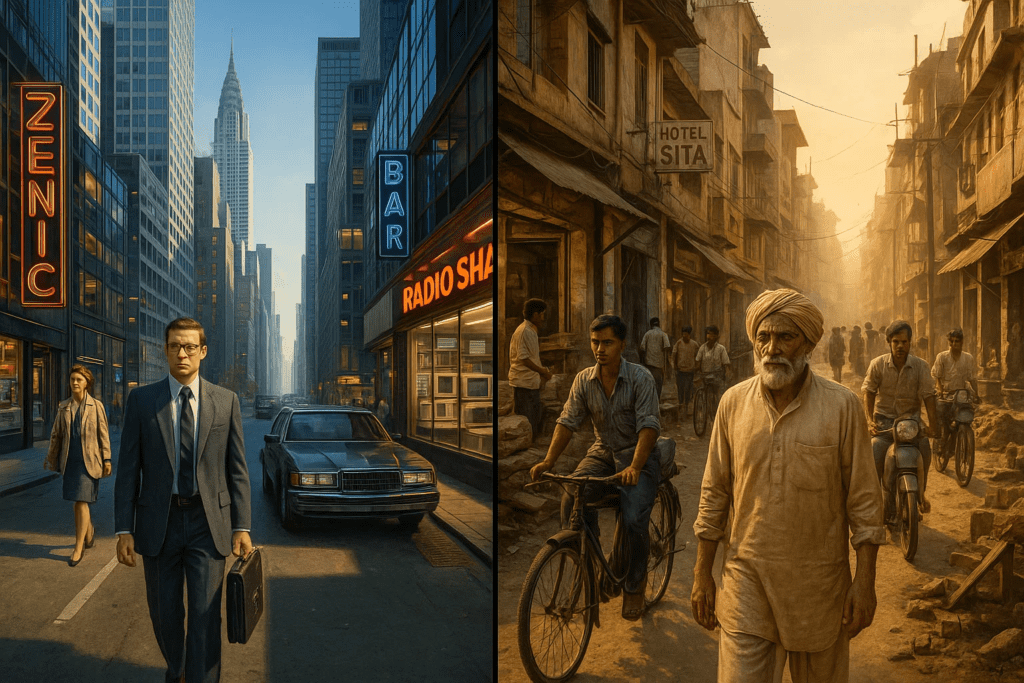
So the big question is:
How did Western countries become so developed by the 1980s and 1990s?
What were they doing right that Asian countries like India were not doing at that time?
This article dives deep into the factors that made the West decades ahead — and how India is now finally catching up.
1. A 100-Year Head Start The Industrial Revolution
The biggest reason behind Western development is something simple:
They started early.
Western countries completed their industrial revolution between 1800–1900, while countries like India started modern industrial growth only after 1991.
What the West built early:
- Large-scale factories
- Mass production systems
- Early machine technology
- Modern transportation and logistics
- Strong innovation culture
This early development gave Western countries a 100-year compound advantage, which Asian countries could not match instantly.
India, for example, became independent only in 1947 and spent its early decades solving poverty, political instability, and basic infrastructure shortages.
2. World-Class Education Systems
By the 1980s and 1990s, Western countries had the best universities and research institutions in the world.
Western education strengths:
- Focus on STEM (science, tech, engineering, math)
- Innovative teaching methods
- Heavy research funding
- Practical, lab-based learning
- Critical thinking and creativity encouraged
Western universities produced:
- Scientists
- Engineers
- Economists
- Tech innovators
- Entrepreneurs
- Global CEOs
Meanwhile, India’s education system remained:
- Theory-heavy
- Based on rote learning
- With limited research culture
- Limited access to quality institutions
India’s large-scale educational transformation began only in the 2000s.
3. Early Adoption of Technology
By 1980–1990, the West already had:
- Personal computers
- Early internet
- Television networks
- Modern banking systems
- Credit cards
- High automobile ownership
- Telecommunication networks
- Semiconductor industry
- Satellites
- Automation and robotics
Technology increases productivity.
And productivity increases development.
India’s major technology penetration began much later:
- Computers (after 2000)
- Internet (after 2004 broadband revolution)
- Smartphones (after 2013–2016)
This is why Western economies were far ahead in tech-driven growth.
4. Capitalism and Open Markets
The Western economic system was based on:
- Free markets
- Private sector growth
- Competition
- Foreign investment
- Innovation-friendly policies
- Low bureaucratic restrictions
This environment creates high-speed economy growth.
India, before 1991, followed a:
- Controlled economy
- License Raj
- Government restrictions
- Capped private sector growth
- No significant foreign investment
It took India until 1991’s economic liberalization to shift toward free markets.
5. Research, Innovation, and Military Technology
Western countries invested billions in R&D (research and development).
This led to:
- New medicines
- Space technology
- GPS
- Nuclear energy
- Jet engines
- Microchips
- Healthcare innovation
- Software revolution
Institutions like:
- NASA
- MIT
- Stanford
- IBM
- Intel
- Microsoft
changed the world.
In comparison, India’s R&D investment remained small.
Western scientific investment advanced their industries at incredible speed.
6. Strong Infrastructure — Built Early
By the 1980s:
- Highways
- Metro networks
- Urban planning
- Stable electricity
- Clean water systems
- Airports
- Telecommunication towers
- Organized housing
were already built in Western nations.
Infrastructure boosts:
- Trade
- Business
- Quality of life
- Investments
- Tourism
- Transport efficiency
India’s major infrastructure growth came after the 2000s, and the biggest boom is happening now between 2014–2030.
7. Political Stability and Strong Governance
Western nations had relatively stable political systems:
- No major internal conflicts after WWII
- Long-term policies
- Low corruption levels
- Predictable governance
- Strong institutions
Stability encourages:
- Investments
- Foreign companies
- Better economic decisions
- Efficient administration
India faced:
- Partition
- Poverty
- Emergency (1975)
- Frequent government changes
- Bureaucratic delays
- Corruption
Political instability slows development for decades.
8. Financial Systems More Advanced
Western countries had evolved financial systems by the 1980s:
- Efficient banks
- Credit systems
- Stock markets
- Venture capital
- Mutual funds
- Insurance markets
- Corporate finance laws
When financial systems are strong:
- People invest
- Businesses grow
- Innovation increases
- Wealth expands
India’s financial markets modernized only after the 1990s.
9. Work Culture and Mindset Advantage
Western societies adopted:
- Professional work culture
- Punctuality
- High productivity
- Respect for skill and talent
- Gender equality in workplace
- Independent mindset
- Risk-taking and entrepreneurship
This mindset created companies like:
- Apple
- IBM
- Microsoft
- Ford
- McDonald’s
India’s mindset in the 1980s was more traditional:
- Preference for government jobs
- Low-risk career choices
- Family pressure
- Limited entrepreneurship culture
Today India has dramatically changed, but the West had a multi-decade head start.
10. The Cold War Advantage (USA’s Benefit)
During the Cold War, the USA invested massively in:
- Defense
- Aerospace
- Research
- Universities
- Technology experiments
- Intelligence systems
These investments created:
- Silicon Valley
- Computer revolution
- Internet
- GPS
- Military technology that became civilian products
America’s global dominance boosted its economy further.
11. Immigration System: The Talent Magnet
Western countries attracted global talent — including India’s best brains.
Every year millions of:
- Scientists
- Engineers
- Doctors
- Researchers
- Skilled workers
moved to the West.
They contributed massively to:
- Tech innovation
- Medical breakthroughs
- Startup ecosystem
India suffered a brain drain, losing its smartest minds to the West from the 1970s to 2000s.
12. Consumerism and Marketing Culture
Western countries had:
- Shopping malls
- Fast food chains
- Brand culture
- Television advertising
- Lifestyle spending
- Credit buying
Consumer spending fuels GDP.
India’s mass consumer lifestyle evolved much later, especially after 2005 with malls, mobile phones, and digital advertising.
13. Computer & Internet Revolution Originated in the West
The biggest advantage:
The digital revolution started in Western countries.
Companies like:
- Apple
- IBM
- Intel
- Microsoft
were born in the US.
They shaped:
- Communication
- Business
- Education
- Finance
- Entertainment
- Global connectivity
India joined the digital revolution seriously after the 2000s.
14. Quality of Life Was Already High
By the 1980s, Western countries had:
- Advanced healthcare
- Clean water
- Sanitation
- High life expectancy
- Better nutrition
- Low poverty
- High literacy
- Social protection systems
When the basics are solved, the economy grows fast.
Asian countries, including India, struggled with:
- Poverty
- Health issues
- Illiteracy
- Poor sanitation
- Limited access to clean water
These challenges slowed development.
Why the West Was So Ahead in the 1980–1990 Era
In simple words:
The West started its development journey 100 years earlier.
India and Asian countries started much later.
And the things they invested in early —
education, technology, research, infrastructure, capitalism —
showed results by the 1980s and 1990s.
Today, the Story Has Changed
Asia, especially India, is rising faster than ever.
Experts say India between 2025–2050 will experience the same kind of explosion in growth and innovation that the West experienced in the 1980s.
Today India has:
- The world’s fastest-growing startup ecosystem
- Rapid infrastructure development
- Strong digital economy
- Youth-driven workforce
- Fastest internet adoption
- Rising manufacturing strength
- Massive global influence
The development that took the West 100 years — India is achieving in 20–30 years.
